Major General Arthur Wellesley’s (later the Duke of Wellington) important defeat of the Mahratta army on 23rd September 1803, opening the way for the British conquest of Central India
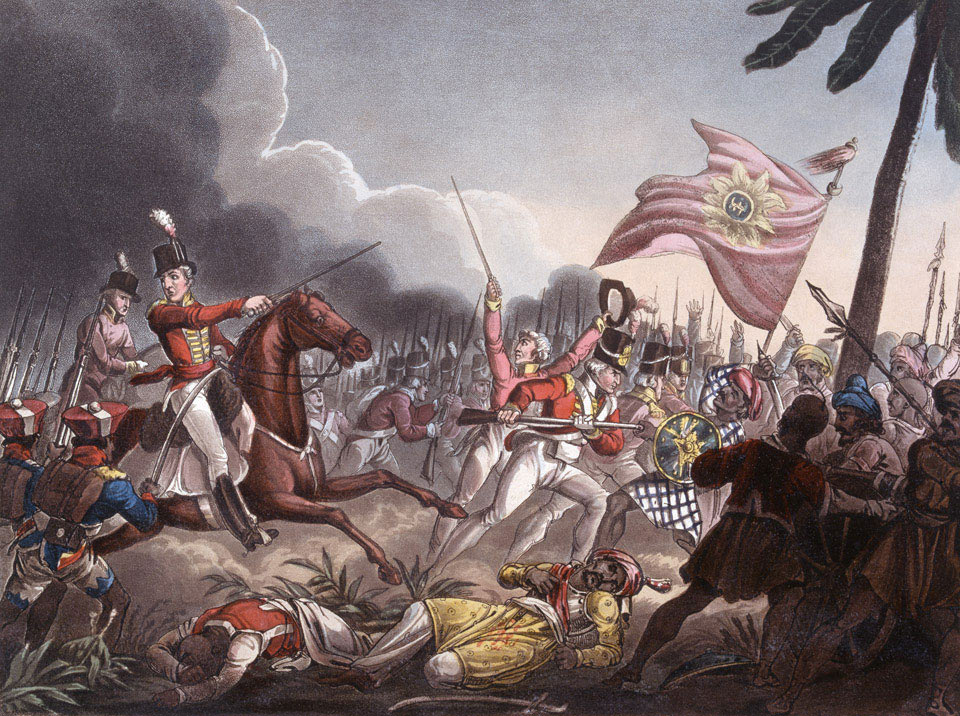
General Arthur Wellesley, later the Duke of Wellington, leading the British attack at the Battle of Assaye on 23rd September 1803 during the Second Mahratta War in India: picture by J.C. Stadler
The previous battle in the British Battles sequence is the Storming of Seringapatam
The next battle in the Second Mahratta War is the Battle of Laswaree
To the Second Mahratta War index
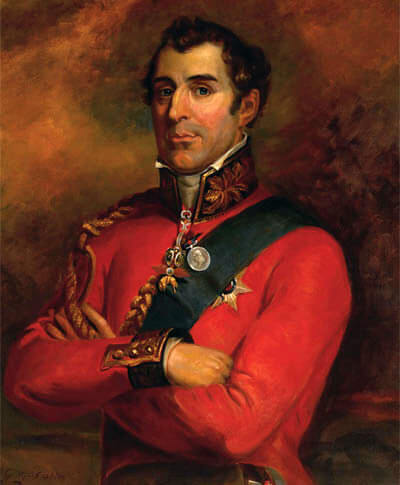
General Arthur Wellesley, later the Duke of Wellington, leading the British attack at the Battle of Assaye on 23rd September 1803 during the Second Mahratta War in India: picture by Robert Home
Battle: Assaye
War: Second Mahratta War
Date of the Battle of Assaye: 23rd September 1803
Place of the Battle of Assaye: Central India
Combatants at the Battle of Assaye: An army of British and Indian sepoy troops from the Madras Presidency against an army of the Mahratta Confederacy.
Commanders at the Battle of Assaye: Colonel, acting Major-General, Arthur Wellesley (later the Duke of Wellington) against Madhaji Scindia, one of the chief rulers of the Mahratta Confederacy.
Size of the armies at the Battle of Assaye: 6,500 British and Madras Presidency Indian troops and Mysore irregular cavalry with around 20 guns against a Mahratta army estimated to be at least 40,000 strong, with more than 100 guns.
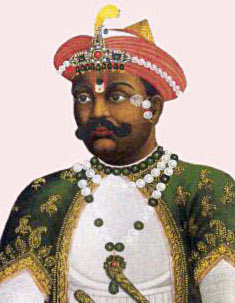
Madhaji Scindia, Mahratta commander at the Battle of Assaye on 23rd September 1803 in the Second Mahratta War in India
Uniforms, arms and equipment at the Battle of Assaye:
The standard firearm for the British and Madras infantry regiments was the muzzle loading flint-lock Brown Bess musket, with an effective range of 100 yards, fired in volleys, and bayonet. The cavalry regiments carried a sword and muzzle loading flint-lock carbine.
The 74th and 78th Highland Regiments wore the kilt but on campaign in India exchanged it for thin linen trousers. Both regiments wore red jackets and feather bonnets.
The Madras regiments wore red jackets and breeches.
The 19th Light Dragoons wore blue jackets and the Tarleton light dragoon helmet.
The Mahratta army comprised a wide variety of fighting men from disciplined European style infantry commanded by mercenary officers and armed with musket and bayonet to hordes of free-moving light horsemen armed with swords and shields.
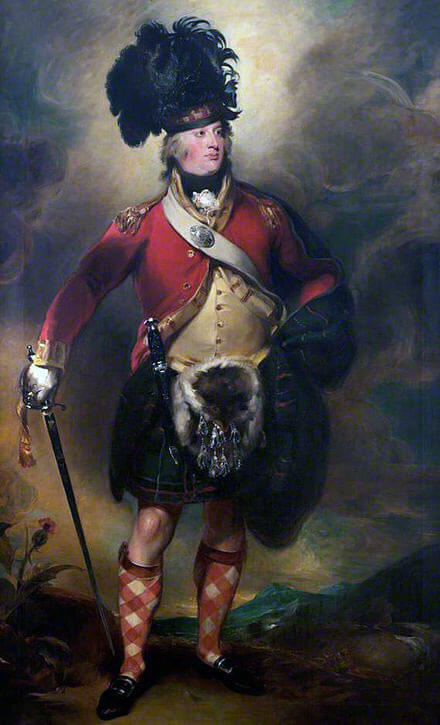
Colonel Francis Humberston Mackenzie who raised the 78th Highlanders: Battle of Assaye on 23rd September 1803 in the Second Mahratta War in India
Both sides possessed muzzle loading artillery.
Winner of the Battle of Assaye:
The Anglo-Indian army of Major-General Wellesley.
British Regiments at the Battle of Assaye:
HM 19th Light Dragoons
HM 74th (Highland) Regiment of Foot
HM 78th (Highland) Regiment of Foot, the Ross-shire Buffs
4th Madras Native Cavalry
5th Madras Native Cavalry
7th Madras Native Cavalry
2nd Madras Native Infantry
4th Madras Native Infantry
8th Madras Native Infantry
10th Madras Native Infantry
12th Madras Native Infantry (2nd Battalion)
Artillery comprising eight 12 pounders, two 5 ½ inch howitzers and some other pieces.
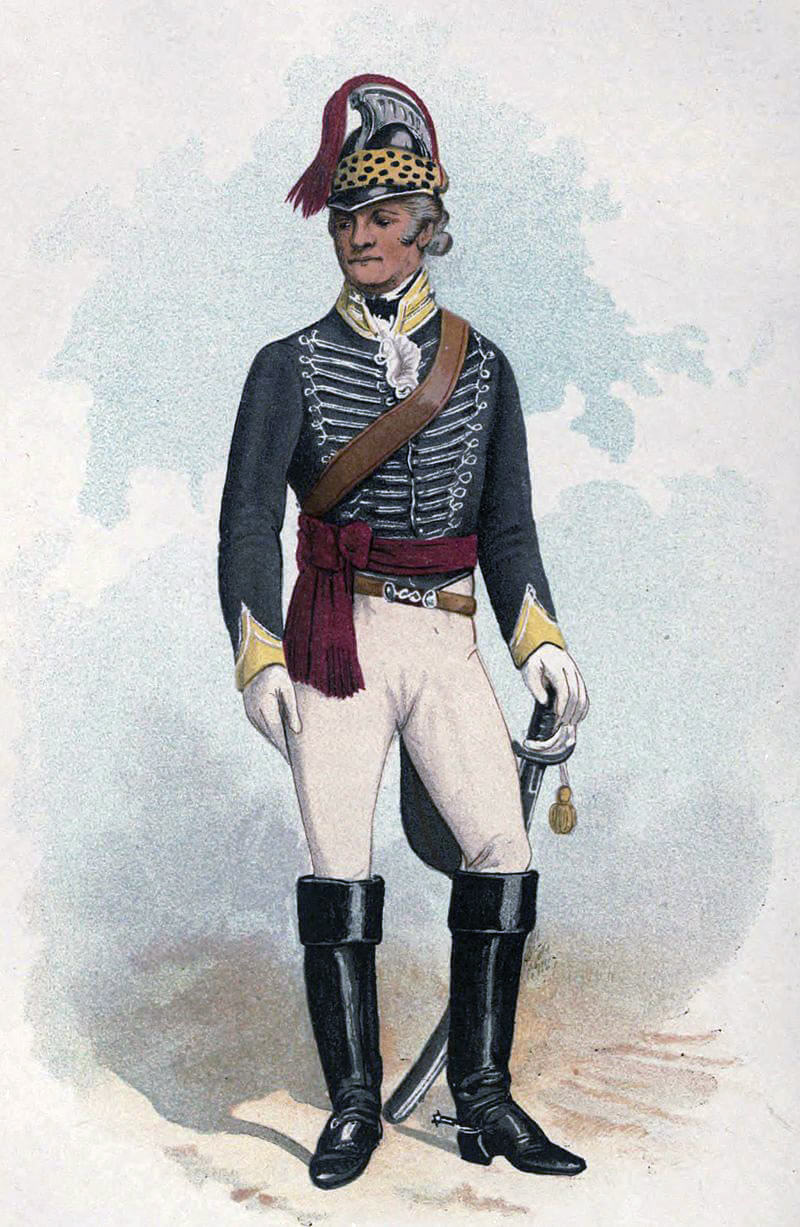
Officer of the 19th Light Dragoons: Battle of Assaye on 23rd September 1803 in the Second Mahratta War in India
Background to the Battle of Assaye:
In 1800, the East India Company, the British governing agency in India, occupied three areas of the sub-continent; the port of Bombay on the west coast of India; an area around Madras, stretching north and south of the city along the east coast; and the substantial presidency of Bengal, based on the trading port of Calcutta in the Hoogli delta. The three presidencies were separated by tracts of country governed by Indian potentates.
In the Deccan, the southern central area of the Indian isthmus, the British controlled the principalities of Hyderabad (not to be confused with Hyderabad, capital of Scind on the border with Persia and now in modern Pakistan) and Mysore in the very south.
Separating the three British presidencies, stretching from coast to coast and up to the borders of Nepal in the North and the Punjab in the West, lay the sprawling Mahratta Confederacy, combining the five principalities of the Peshwa Baji Rao, Daulat Rao Sindhia, Jeswant Rao Holkar, the Bhonslar Raja of Berar and the Gaikwar of Baroda.
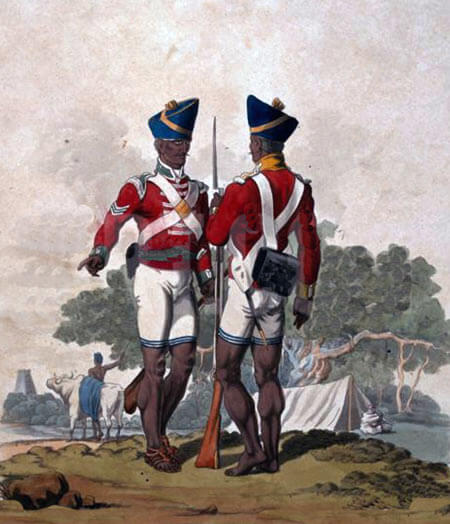
Sepoys of the Madras Army: Battle of Assaye on 23rd September 1803 during the Second Mahratta War in India: picture by Charles Hamilton Smith
Sindhia included the old Moghul capital of Delhi in the North with a garrison of French trained troops.
In 1802, war broke out within the Confederacy, with Holkar and Berar defeating the Peshwa and Sindhia and driving the Peshwa from his territory to seek refuge with the East India Company.
The British Governor-General, the aggressive and resourceful Lord Mornington, seized on the pretext of re-instating the Peshwa in his capital, Poona, close to the British city of Bombay, to invade the Confederacy from Mysore in the South and from Oudh in the North.
The incursion from Mysore was commanded by Lord Mornington’s younger brother, Colonel, acting Major-General, Arthur Wellesley, later the Duke of Wellington.
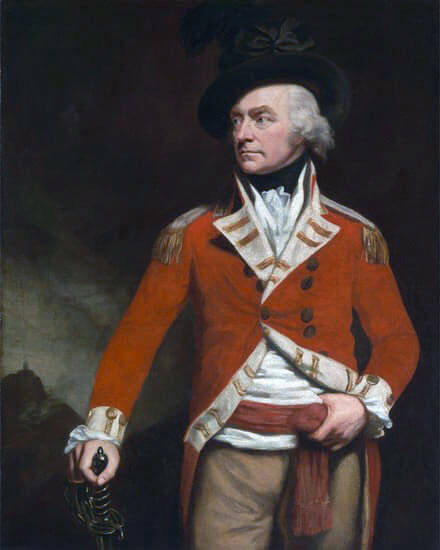
Officer of the 74th Highland Regiment in India: Battle of Assaye on 23rd September 1803 in the Second Mahratta War in India
Wellesley, after a notable part in the Mysore Wars, had for some time planned the inevitable incursion into the Mahratta Confederacy. His extensive intelligence network provided him with full descriptions of the countryside, towns and fortifications he would encounter. Based on this information, Wellesley gave his brother a report setting out how the campaign would develop, advising that it be fought during the monsoon, so that the flooding rivers would hinder the fast-moving Mahratta light cavalry.
In the event, the Mahratta army of Sindhia and Berar – the force Wellesley had to deal with in this section of the war; General Lake fighting with Holkar’s army in the area of Delhi in the North – encumbered itself with a substantial force of infantry, severely restricting its mobility.
In March 1803, Wellesley crossed into the Confederacy from Mysore and marched on Poona, where he restored the Peshwa to his principality, while the Mahratta army fell back. A second force under Colonel Stevenson crossed the border from Hyderabad, its role being to protect Hyderabad from attack.
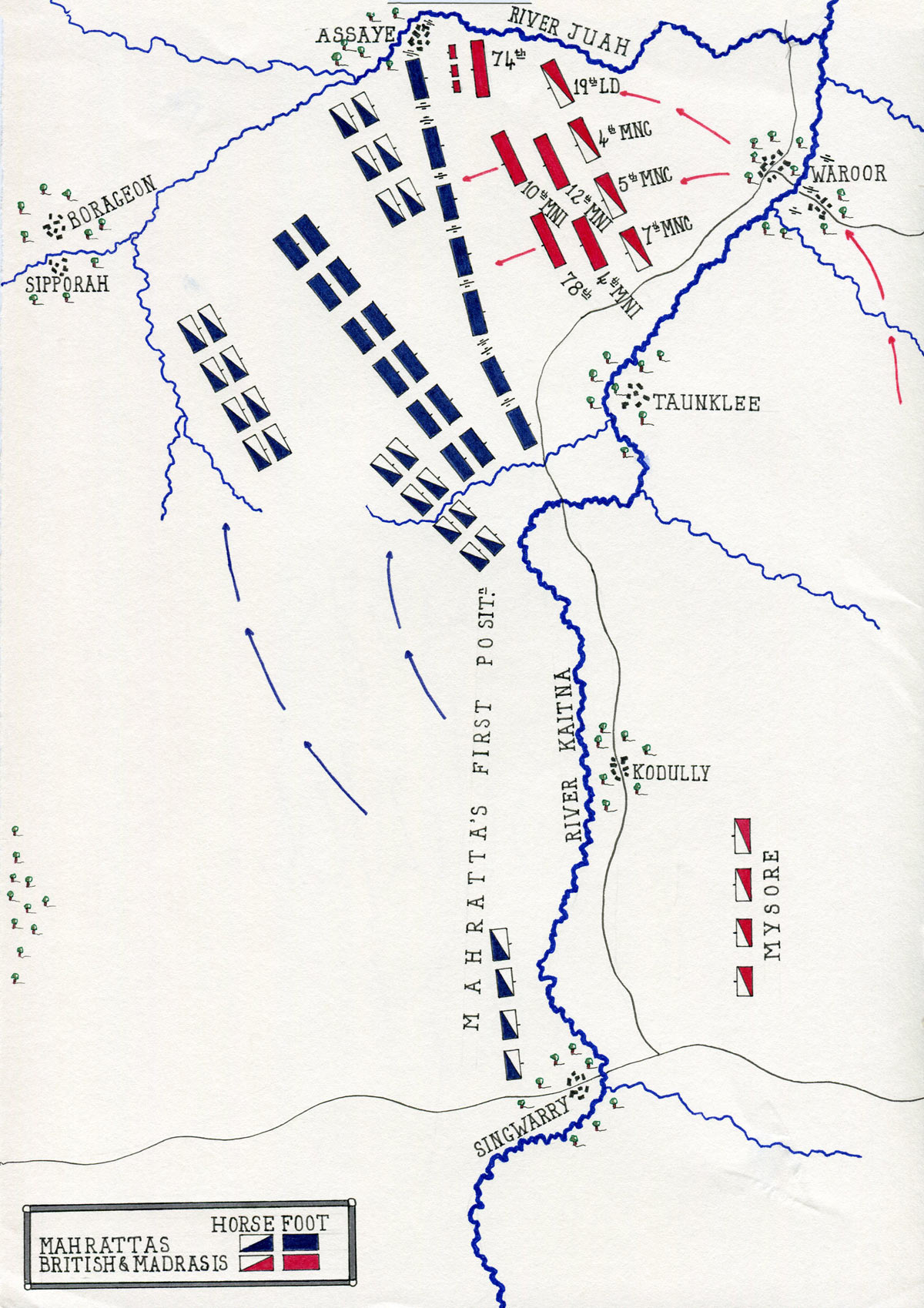
Map of the Battle of Assaye on 23rd September 1803 during the Second Mahratta War in India: map by John Fawkes
Account of the Battle of Assaye:
Wellesley, with his British and Madras native regiments, pursued the retreating Mahratta army to the North East, acting in concert with, but separate from Stephenson’s force.
On 23rd August 1803, Wellesley reached Naulniah, where information came in that the Mahratta army was just six miles distant and about to move off.
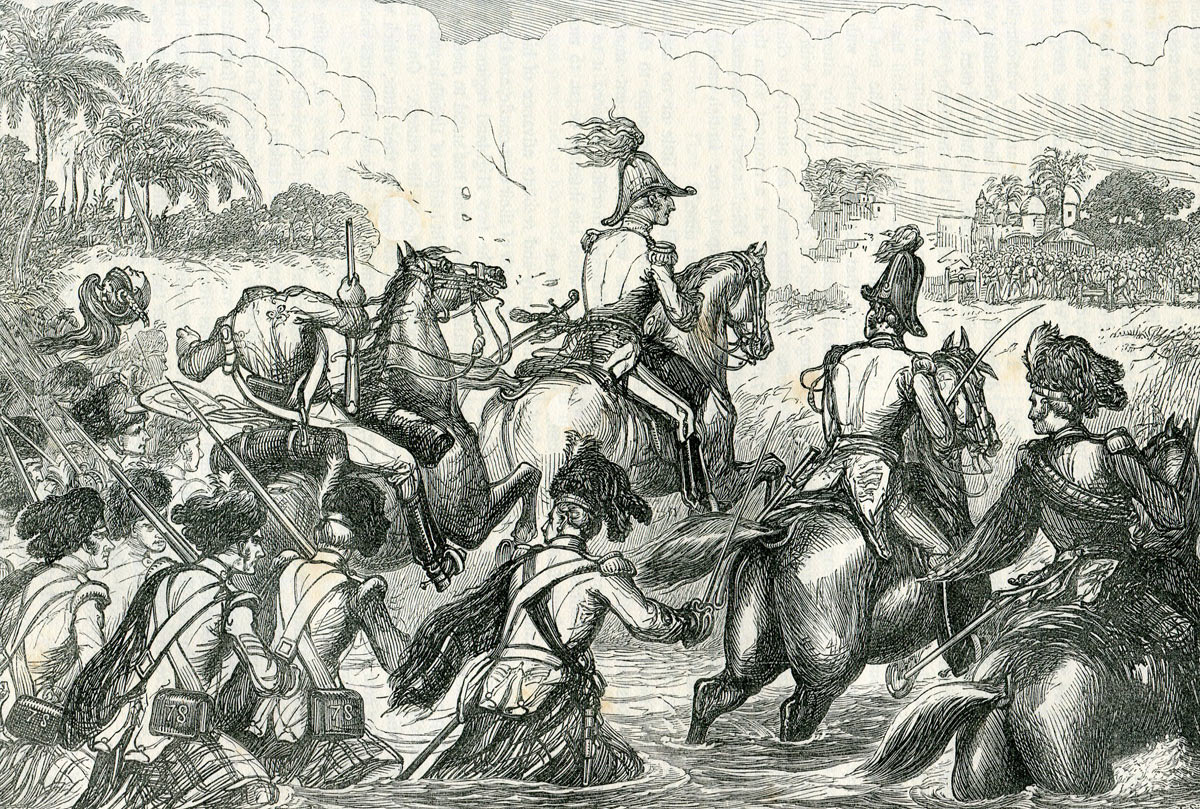
Sir Arthur Wellesley leading the Highlanders across the Kaitna River at the Battle of Assaye on 23rd September 1803 in the Second Mahratta War in India
The large numbers of Mahratta horsemen forced Wellesley to conduct his reconnaissance of the Mahratta position with the whole of his cavalry brigade.
Wellesley came up with the Mahratta army and found that, far from withdrawing, the Mahrattas were in position behind the Kaitna, a steep-banked river presenting a formidable obstacle. The Mahrattas were ready for battle; with 30,000 horsemen massed on their right and 12,000 infantry on their left; 16 battalions trained and led by French officers, in lines and interspersed by 100 guns.
Without hesitation, Wellesley resolved to attack.
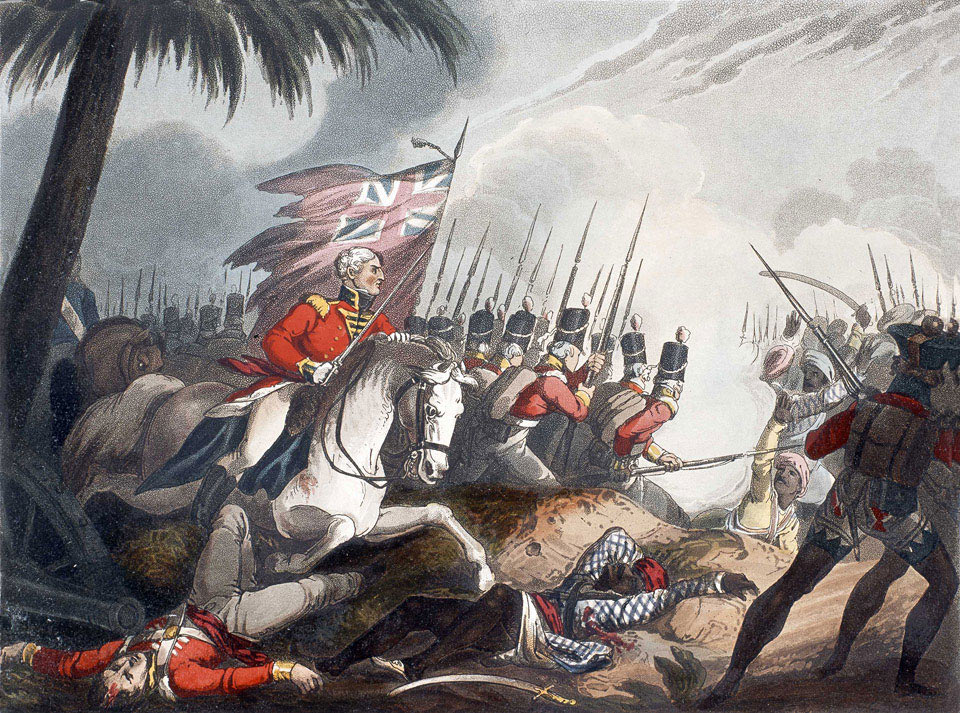
General Arthur Wellesley, later the Duke of Wellington, leading the British attack at the Battle of Assaye on 23rd September 1803 in the Second Mahratta War in India: picture by William Heath
Wellesley’s force comprised 4 cavalry regiments; HM 19th Light Dragoons and 3 Madras native regiments; 7 infantry regiments; HM 74th and 78th regiments of Highlanders and 5 Madras native regiments; with a force of irregular cavalry from Mysore; 6,500 men and 22 guns in all.
Wellesley moved with his cavalry brigade up the river, until he identified a point beyond the left flank of the Mahratta position, where villages on each bank indicated a passable ford.
As the main body of his army came up, Wellesley directed his infantry to cross the ford and attack the Mahratta flank, accompanied by four 12 pounder guns.
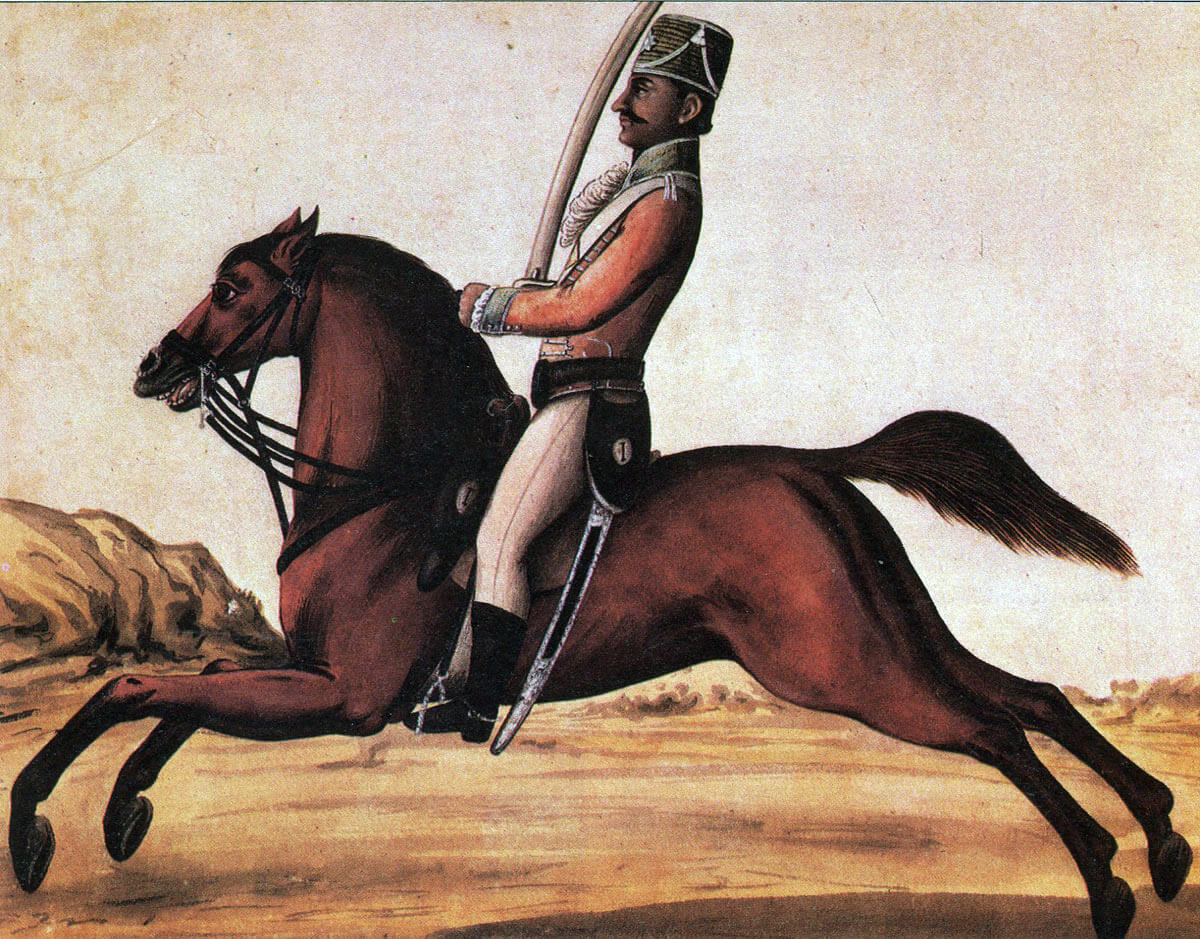
British sowar: Battle of Assaye on 23rd September 1803 in the Second Mahratta War in India
Wellesley’s infantry formed up in two lines on the far bank, with the British regiments on the outside flanks, the 74th opposite Assaye, the 10th Madras Native Infantry in the centre of the first line and the 4th and 12th Madras Native Infantry in the second.
The 19th Light Dragoons and the 3 Madras cavalry regiments formed the reserve. The Mysore cavalry remained on the near bank of the Kaitna.
Once Wellesley’s intentions were recognised, the Mahratta commanders moved their army, establishing a new line across the isthmus formed by the Kaitna and Juah rivers, their left flank now resting on the village of Assaye.
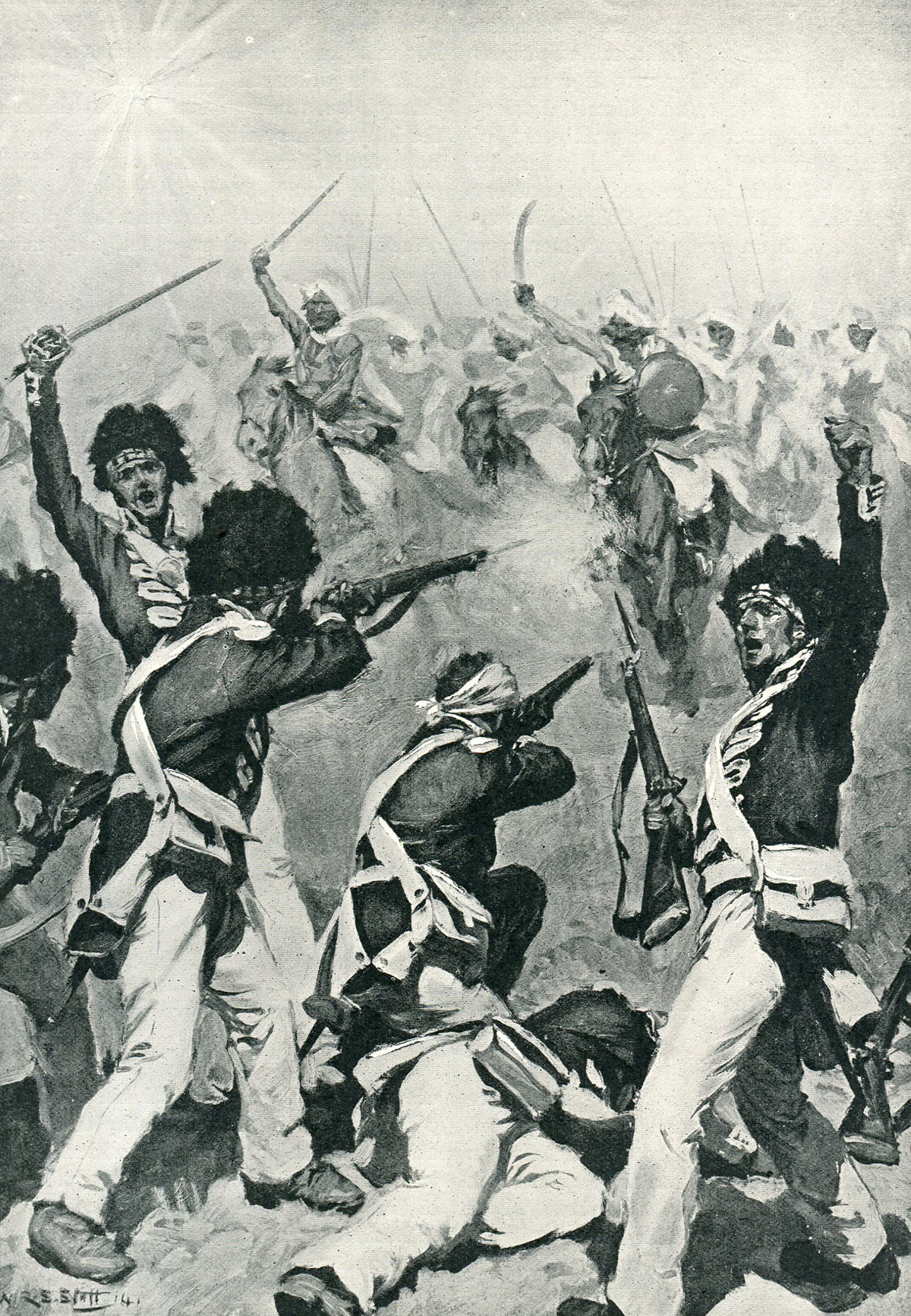
74th Highlanders attacked by the Mahratta Cavalry at the Battle of Assaye on 23rd September 1803 during the Second Mahratta War in India: picture by W.R.S. Stott
The Mahratta guns subjected the Highlanders and Madrassis to a heavy fire, as they marched to the river, crossed the ford and advanced to the attack. The Mahratta gun-fire was particularly heavy from Assaye against the 74th Highlanders, advancing behind a screen of skirmishers from the 2nd and 8th Madras Native Infantry.
Wellesley, in his dispatch after the battle, stated that the 74th veered to the right in support of the skirmishers and towards the guns that were firing at them, opening up a gap between the 74th and 10th Madras Native Infantry.
At some point, the British/Madrassi line came to an extended ridge, where the troops paused before continuing forward.
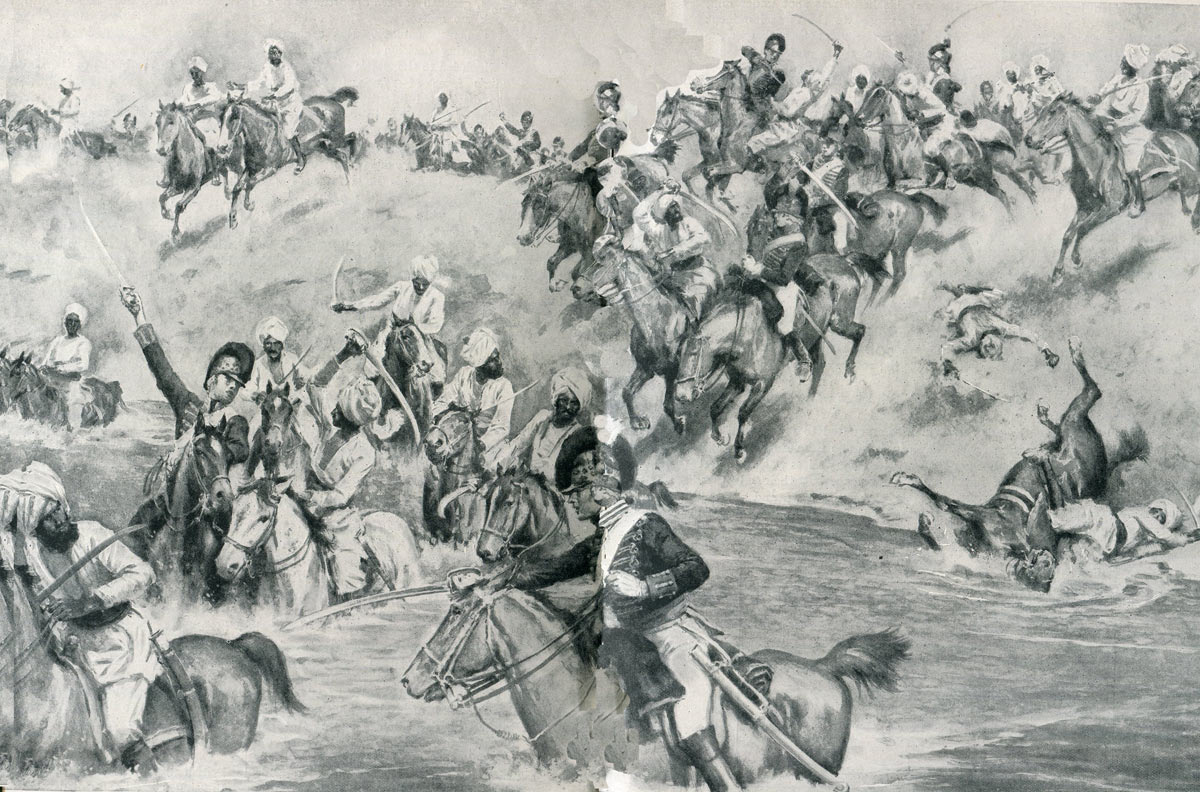
19th Light Dragoons attack the Mahratta Cavalry at the Battle of Assaye on 23rd September 1803 during the Second Mahratta War in India: picture by Wal Paget
In the advance on Assaye, the 74th came near to being annihilated, the Mahratta light cavalry swarming forward through the remnants of the regiment and the gap to its left. The 19th Light Dragoons and 4th Madras Native Cavalry charged up from the rear, driving the Mahratta horse back through the British line and continued their attack into the main Mahratta position.
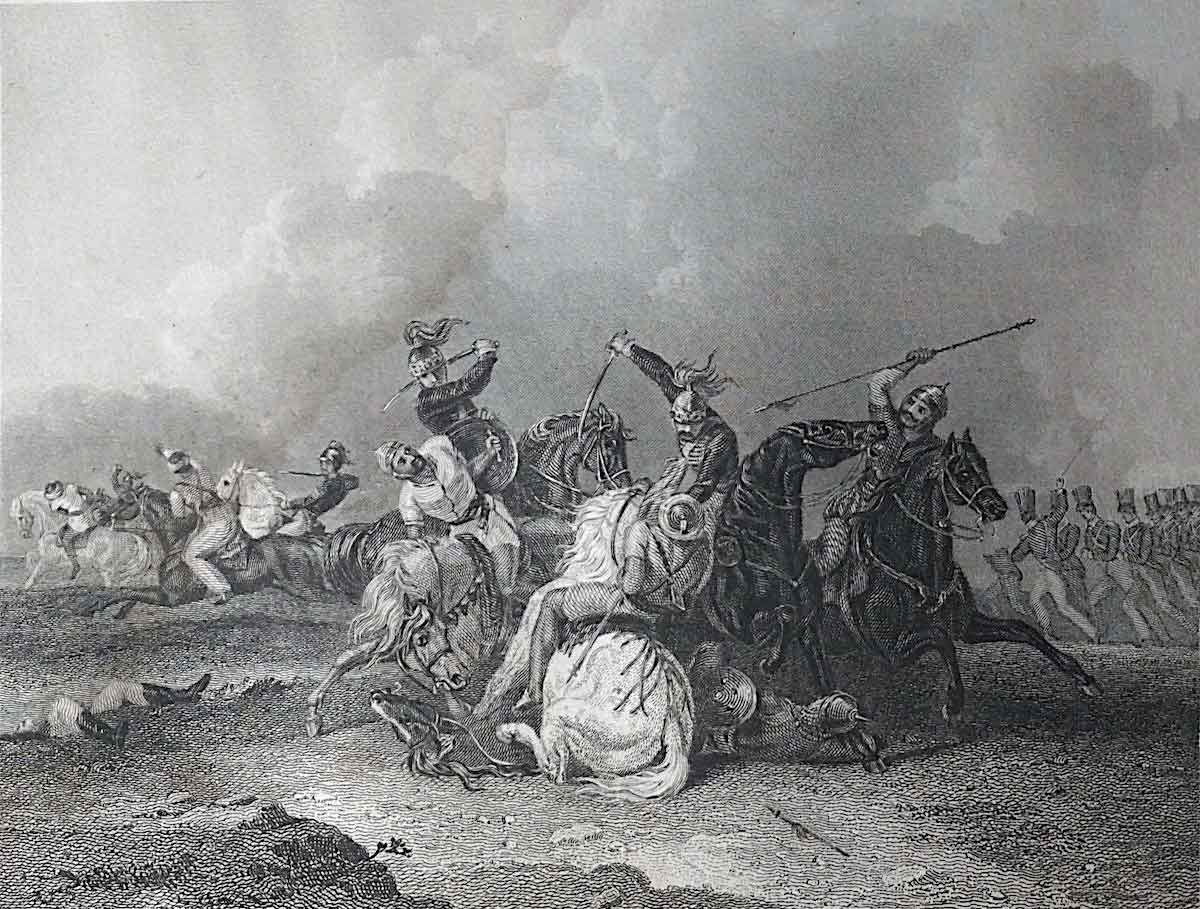
Colonel Maxwell’s last charge on the Mahratta Cavalry at the Battle of Assaye on 23rd September 1803 during the Second Mahratta War in India: print by Cooper
On the British left, where the artillery fire was less heavy, the 78th Highlanders and Madras Native Infantry stormed the Mahratta line and pushed on, the French officers commanding the Mahratta battalions in the front line apparently abandoning their soldiers and riding for the rear, leaving a number of these battalions to break up.
The practice for Mahratta gunners, on being overrun, was to feign death under their guns, wait for the enemy to pass and resume fire, now into the rear of the attackers. This they did, catching the British and Madras regiments in the rear with a renewed bombardment. The 78th turned back and with the 7th Madras Native Cavalry retook the guns, after a determined fight with the gunners. This time, care was taken to ensure that those appearing to be dead were dead.
The success of Wellesley’s attack, in spite of the heavy losses to the 74th, caused the Mahratta army to break up and retreat to the North-East, pursued for a distance by the 19th Light Dragoons and the Madras cavalry regiments, and abandoning 98 guns on the battlefield. Stevenson’s Hyderabad force took up the pursuit.
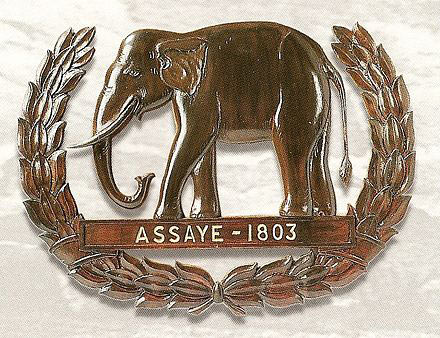
Elephant badge of the Madras Sappers and Miners awarded after the Battle of Assaye on 23rd September 1803 during the Second Mahratta War in India
Casualties at the Battle of Assaye:
Mahratta casualties at the Battle of Assaye are said to have been around 5,000 killed, wounded and captured.
The Anglo-Indian force suffered 22 officers and 386 men killed and 57 officers and 1,526 men wounded. One third of Wellesley’s force became casualties in the battle.
The 74th Highlanders suffered around 400 casualties out of a strength of 500. It is said that every one of the 74th’s officers became casualties in the battle, 11 being killed. The commanding officer of the 19th Light Dragoons, Lieutenant Colonel Patrick Maxwell, who also commanded the cavalry brigade was killed.
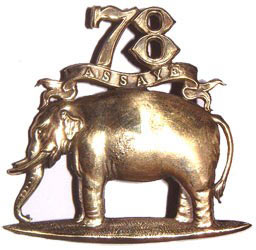
Elephant badge of the 78th Highlanders awarded after the Battle of Assaye on 23rd September 1803 during the Second Mahratta War in India
Follow-up to the Battle of Assaye:
Colonel Stevenson pursued the defeated Mahratta army, taking the fortress of Asirgarh, until peace was negotiated in mid-November 1803. The final phase of the Second Mahratta War broke out the same month, with the Mahrattas finally defeated in 1818 at the end of the Third Mahratta War, thereby assuring the British position in Central India.
Wellesley’s older brother, Lord Mornington, the Governor General of Bengal, was ecstatic at the news of the victory at Assaye.
Assaye was seen as a decisive battle in the establishment of British influence and power in Central India and established Wellesley’s reputation in India.
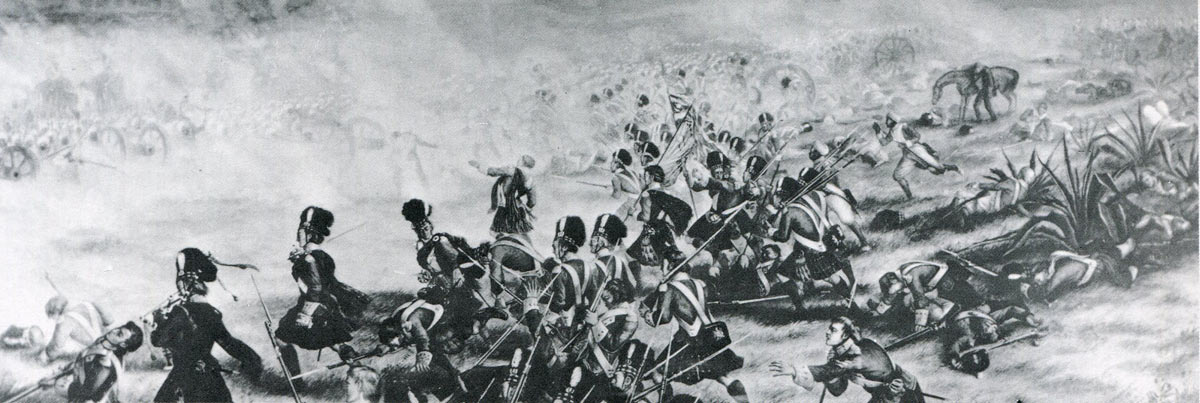
74th Highlanders at the Battle of Assaye on 23rd September 1803 during the Second Mahratta War in India
Anecdotes and traditions from the Battle of Assaye:
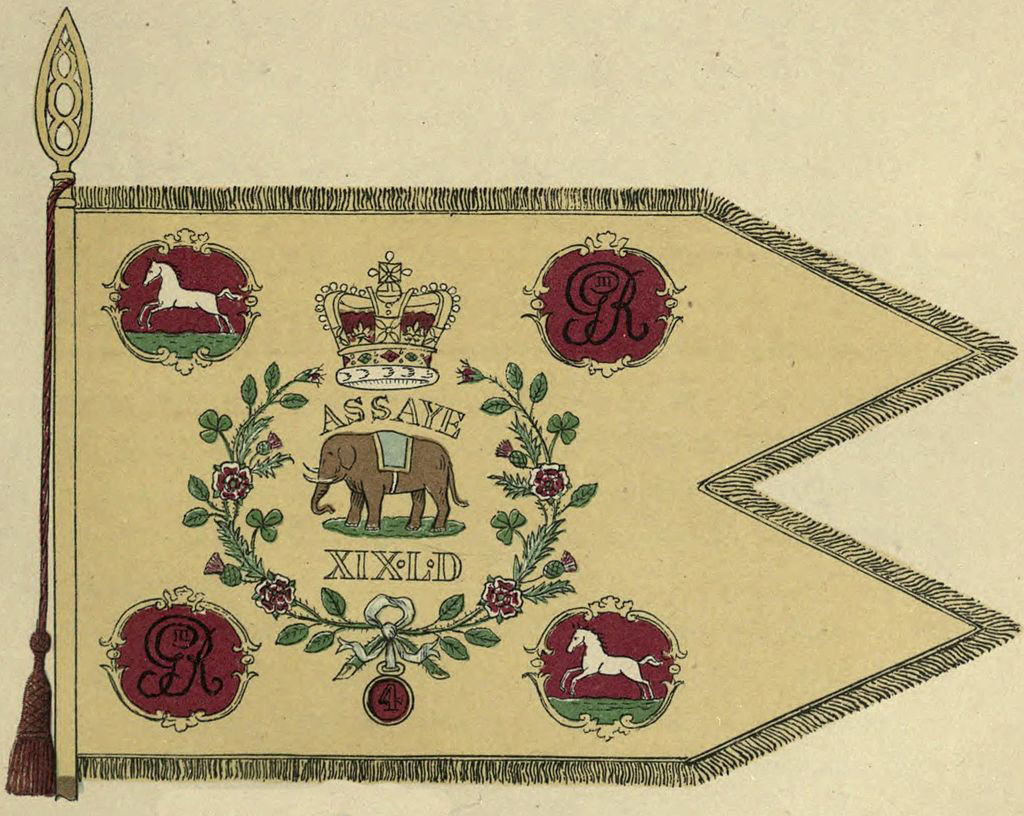
Assaye ‘Elephant’ Guidon of the 19th Light Dragoons: Battle of Assaye on 23rd September 1803 during the Second Mahratta War in India
- In later life, the Duke of Wellington, when asked which was his hardest fought battle, would say “Assaye”. He described the Mahratta gun-fire against the advancing 74th Highlanders as the heaviest that had been known in India.
- Wellesley had two horses killed under him in the battle and his orderly, riding at this side, was decapitated by a cannon shot. Every officer on his staff lost one or two horses.
- Wellesley is reported to have said before the Battle of Assaye “If I do not give battle to the enemy there will be nothing left for me but to hang myself from my tent pole.”
- Following the battle the 74th became known as, “the Assaye Regiment”.
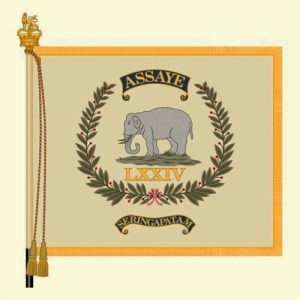
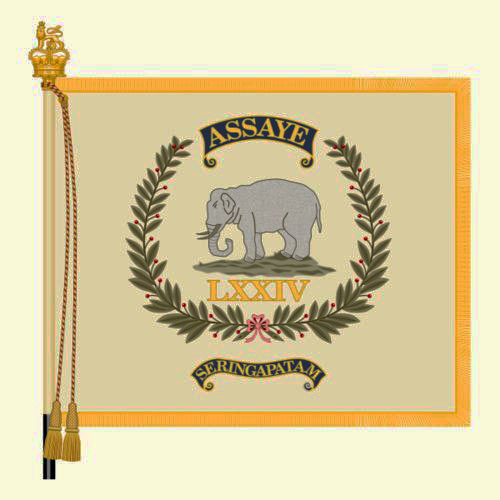
Assaye Colour of the 74th Highlanders: Battle of Assaye on 23rd September 1803 during the Second Mahratta War in India
- With almost all the 74th’s officers casualties, Quartermaster James Grant joined the ranks of the regiment from his post with the ammunition at the rear and assisted the one remaining, but wounded, officer, Major Swinton, in leading the regiment for the remainder of the battle. At the annual parade in commemoration of the battle, the Assaye colour was carried by the quartermaster, in memory of the actions of James Grant.
- The Governor General awarded special colours to the three British regiments; the 74th and 78th Highlanders and the 19th Light Dragoons, and to the Madras regiments. The 74th, 2nd Battalion the Highland Light Infantry from 1882, trooped its colour every year on the anniversary of Assaye. There is no record that the 78th, from 1882 2nd Battalion the Seaforth Highlanders, made any such use of their colour. Each regiment that fought at the Battle of Assaye was awarded an elephant as its badge.
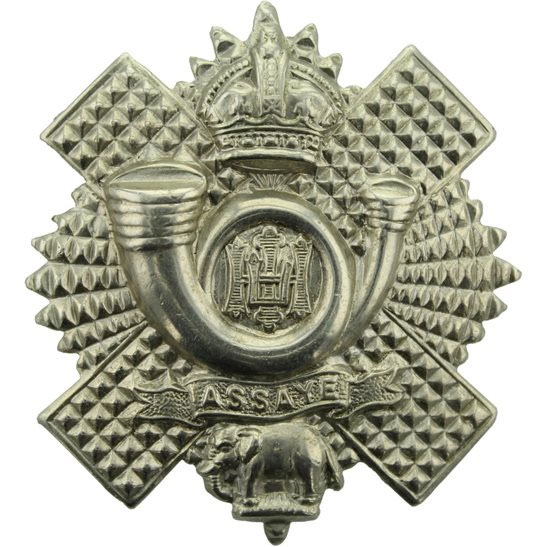
Badge of the Highland Light Infantry, formerly 71st Regiment, with Assaye Elephant from the Battle of Assaye on 23rd September 1803 during the Second Mahratta War in India
- The 19th Light Dragoons was raised specifically for service in India. The regiment returned to England in 1806 and took part in the War of 1812 in North America. It was disbanded in 1821. A new 19th Royal Hussars was raised in 1862 and took the old regiment’s battle honours, being the only British cavalry regiment with the battle honour ‘Assaye‘.
References for the Battle of Assaye:
Fortescue’s History of the British Army.
The Decisive Battles in India by Malleson
Wellington: The Road to the Lion’s Mound 1769-1815 by Daniel Res
The previous battle in the British Battles sequence is the Storming of Seringapatam
The next battle in the Second Mahratta War is the Battle of Laswaree
To the Second Mahratta War index